

Cotton fields to manufacturing : When Heat Became a Hidden Disruption
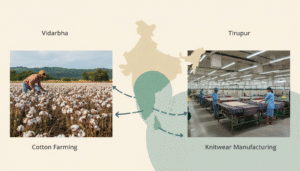
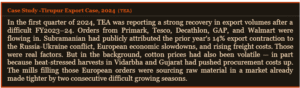
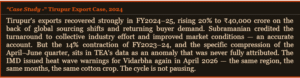
In February 2024, K.M. Subramanian, President of the Tirupur Exporters’ Association (TEA), was fielding orders from European buyers for summer apparel. TEA represents over 1,360 knitwear units across Tirupur, a city in Tamil Nadu’s interior that accounts for 90% of India’s cotton knitwear exports and clocked ₹44,747 crore in export revenue in FY2024–25.
The delivery timelines being agreed upon — June, July, August — were well within normal parameters for a region that had been exporting knitwear for decades. There was nothing in the early-year data to suggest the coming season would be unusual. Vidarbha, the cotton-growing belt of eastern Maharashtra that supplies a significant share of Tirupur’s raw material. Meanwhile, It was still in its dormant pre-harvest phase, and temperatures across Tamil Nadu itself were unremarkable.
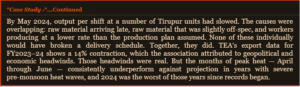
What followed over the next several months illustrated a problem. India’s supply chains are increasingly susceptible to climate change disruption. These emerging heat risks in India’s supply chain are rarely accounted for in formal planning. Consequently, A heat wave concentrated in one region can systematically disrupt production in another, hundreds of kilometres away, through a sequence of failures that each look like ordinary business risk.
The 2024 Indian heat wave, confirmed by the Indian Metrological Department (IMD) as the worst since 1901. It drove temperatures in central India’s cotton belt to record levels during the exact months that determined raw material quality, freight reliability, and factory output for the summer export season. Consequently, these disruptions began to cascade through the supply chain. By the time they appeared in Tirupur’s shipping data as delayed consignments, renegotiated contracts, and compressed margins. There was no single entry in any ledger that explicitly recorded “heat.” Indeed, there rarely is.
What follows is an examination of how that sequence unfolds. From a cotton field in Vidarbha to a missed export deadline in Tirupur, and why the link between the two is so consistently overlooked.
Table 1: Key statistics — 2024 Indian heat wave

Source: Down to Earth — India Extreme Weather 2024
The cotton fields of Vidarbha
Vidarbha — the eastern stretch of Maharashtra, covering districts like Akola, Amravati, Nagpur, and Yavatmal, is one of India’s most important cotton-growing regions. Moreover, according to the IMD records, it is among the most heat-stressed zones in the country during the pre-monsoon months. Over a 52-year dataset, heat wave days across Vidarbha show a clear upward trend, with four out of seven tracked stations recording more frequent and severe events each decade. In April 2024, Akola hit 47.2°C — among the highest readings ever recorded in the region.
| WHAT THE RESEARCH SAYS |
| A 2025 study in BMC Plant Biology testing multiple cotton cultivars under heat stress found that seed cotton yield fell by an average of 19% and lint yield by 26%. Additionally, a separate experiment that raised temperatures by just 2–3°C during the boll period recorded a 30–40% drop in total cotton yield. There were measurable reductions in fiber length and strength. [PubMed / Nanjing Agr. University] |
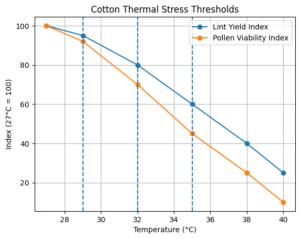
| Cotton lint yield declines rapidly above 32°C, and fruiting efficiency begins dropping above 29°C — thresholds Vidarbha regularly and increasingly exceeds during the exact months when the crop is most vulnerable. [Frontiers in Genetics, 2025] |
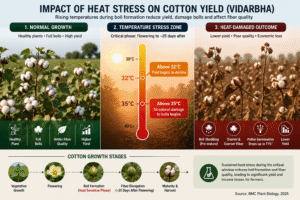 Source– BMC Plant Biology, 2025
Figure 1: Cotton thermal stress thresholds
How cotton lint yield and pollen viability fall as temperature rises — indexed to 100 at 27°C
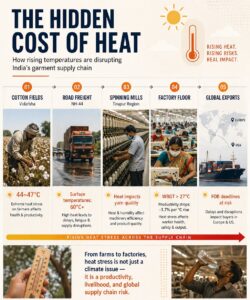
After a heat-stressed Vidarbha harvest, Tirupur’s spinning mills do not receive visibly damaged cotton.; rather, It is cotton that passes basic inspection but spins differently. Shorter staple lengths mean higher thread breakage rates on spinning frames. Elevated micron Aire values — a measure of fibre coarseness — mean the yarn comes out slightly less uniform. Mills compensate by blending, adjusting tension settings, and accepting a higher rate of yarn waste. All of this adds cost and time. Neither shows up on the invoice as ‘heat damage’; Instead, it shows up as price renegotiations and slightly tighter margins on contracts already signed months earlier.
Road freight through the summer corridor
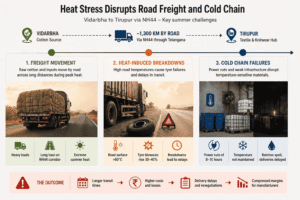
India moves roughly 60% of its freight by road. For Tirupur’s supply chain, this means raw cotton from Vidarbha travels by truck south through Telangana and into Tamil Nadu , mostly along National Highway 44, one of the country’s longest arterial routes. During summer, this corridor becomes operationally difficult in ways that rarely appear in trade data but are well understood by logistics managers.
Road surface apparent temperatures on Indian highways in May can exceed 60°C in the afternoon. At such temperatures, tyre rubber which expands with heat builds up internal pressure faster than its rated operating limits. Heavy loads and prolonged high temperatures can cause tyre blowouts by exceeding internal air pressure limits. As a result freight operators informally account for 30–40% more breakdown time during peak summer months. A blown tyre halts the vehicle, leaving cargo in the heat and the driver waiting for assistance. For heat-sensitive cargo — dyes, chemical auxiliaries, certain packaging materials — those hours matter. These disruptions reflect how heat risks in India’s supply chain affect transport reliability.
The cold chain problem is related but distinct. Specifically, dye chemicals and fabric treatments in Tirupur must be stored and transported below specific temperatures for stability. India’s cold chain network is fragile and unevenly distributed. During peak summer 2024 which overlapped with the general election period several regions reported extended power outages lasting multiple hours as grid demand surged under extreme heat conditions. For instance, reports from Maharashtra, for instance, documented outages ranging up to several hours in affected districts. Consequently, cold storage facilities without reliable diesel backup cannot maintain temperature and batches spoil. As a result, Suppliers absorb the loss, or renegotiate, or delay delivery while sourcing a replacement batch. Each of these outcomes costs days.

What happens on the factory floor
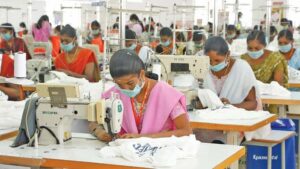 Source: apparelresources
Tirupur employs approximately six lakh workers in its knitwear sector, 65% of whom are semi-literate women who have migrated from rural Tamil Nadu. Their work — cutting, stitching, finishing, quality inspection — is precise, repetitive, and physically demanding. It is also performed largely without air conditioning.
The standard measure of occupational heat stress is not the dry air temperature that a thermometer records, but the Wet Bulb Globe Temperature (WBGT) — a composite index that accounts for air temperature, humidity, radiant heat from surfaces, and air movement together. WBGT reflects what the human body actually experiences. ISO standard 7933, the international framework for predicting physiological heat strain in workers, establishes that productive capacity begins declining at a WBGT of 25°C. Above 30°C, the decline becomes significant. Above 40°C, sustained work becomes physiologically untenable for most people.
Tirupur’s factories use evaporative coolers — devices that lower temperature by pushing air over water-soaked pads, relying on evaporation to carry heat away. This works when the ambient air is dry, because dry air can absorb the evaporated moisture. In May and June, when Tamil Nadu’s relative humidity climbs above 60%, the air is already carrying too much moisture to absorb more. Evaporation slows, and with it, cooling. The coolers run but the temperature on the factory floor stays high regardless.
A 2014 study at workplaces across Chennai found that 82% of workers exceeded international WBGT safety thresholds during the hot season. A separate 2018 study tracking garment workers found that, above a Wet Bulb Temperature (WBT) of 27°C, each additional degree reduces sewing line productivity by 3.7% in South and Central India. Moreover, absenteeism compounds this effect: the same study found that a one-degree rise in the 10-day average temperature increases the probability of a garment worker being absent on a given day by 10%.At the factory level, heat risks in India’s supply chain translate into reduced productivity and higher error rates.
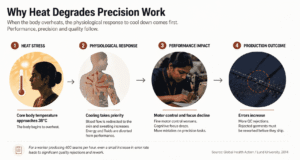
Figure 2: Heat stress and garment worker productivity
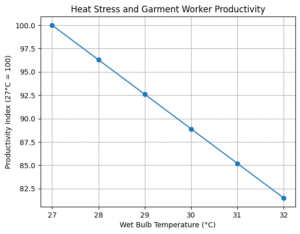
Productivity index at rising Wet Bulb Temperature (WBT), indexed to 100 at 27°C. Based on findings from Becker Friedman Institute Working Paper (2018), showing an average 3.7% decline in productivity per °C increase above 27°C for sewing line workers in South and Central India.
“Nearly four in five garment workers said they avoided taking breaks because they worried about not meeting production targets. Workers reported having fixed break times but said it is difficult to take an extra break even if they feel tired or hot.”
Source: IndiaSpend — As India Braces for Summer, Informal Workers Have Little Heat Protection
The export deadline and impact of heat stress
European and American fast-fashion buyers place summer apparel orders on Free-on-Board (FOB) terms. This means the exporter is responsible for getting the goods onto a container vessel by a specific date. The vessel does not wait. If a shipment misses its booking, the exporter must rebook on the next available sailing — typically 7 to 10 days later — and bear the cost of the delay. Depending on the contract terms, the buyer may also apply penalty clauses or refuse the shipment entirely if it arrives after the selling window has closed.
Table 2: The Tirupur supply chain — where heat enters each stage
Sources: IMD Heat Wave Guidance · TEA Export Data · ISO 7933 · BMC Plant Biology (2025) · BFI Working Paper (2018)
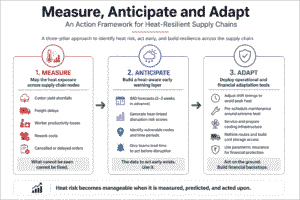
Measure, Anticipate and Adapt: An Action Framework for Heat-Resilient Supply Chains
Heat-linked losses do not announce themselves. They dissolve quietly into higher input costs, unexplained delivery failures, and shrinking quarterly margins — absorbed, but never attributed. Reversing this requires a structured response built on three pillars.
- Measure: Map the Heat Exposure
The first step is visibility. The economic impact of heat on individual supply chain nodes — cotton yield shortfalls, freight delays, worker productivity losses, rework costs, cancelled orders — is currently nowhere systematically tracked. These losses get folded into aggregate figures and their root cause disappears. Until each is measured separately and linked to temperature data, no business case for mitigation can be built, and no risk can be meaningfully managed. What cannot be seen cannot be fixed. Addressing heat risks in India’s supply chain requires systematic measurement and planning
- Anticipate: Build a Heat-Aware Early Warning Layer
The data to act early already exists. IMD’s historical climate datasets and its extended-range prediction system can forecast heatwave onset two to three weeks in advance with reasonable accuracy. Overlaying these climate signals onto supply chain operations data can generate heat-linked disruption risk scores for individual production nodes, flag which parts of the chain are most exposed and in which months, and give procurement, logistics, and production teams the lead time to respond before a disruption — not after. The technology is ready. What is missing is a structured framework for reading climate and operations data together.
- Adapt: Physical and Financial adaptation tools
Once heat-stress nodes are mapped and signals are in place, the response can be both operational and financial. At the factory level, adaptation does not demand heavy capital — it demands better planning. Shift timings can be adjusted to avoid peak afternoon heat, maintenance can be pre-scheduled around extreme heat windows, and cooling infrastructure can be serviced before the season rather than during it. Route plans can be rethought for heat-linked interruption risks and cold storage access built into logistics design. And at every node — from the cotton farm to the warehouse to the last-mile carrier — parametric insurance can provide a data-driven financial backstop, triggering payouts automatically when heat thresholds are breached, without the friction of conventional claims.
The tools, the data, and the financial instruments to build heat-resilient supply chains already exist. What we require is intent — and a framework to bring them together.
“Give me six hours to chop down a tree and I will spend the first four sharpening the axe.”
Abraham Lincoln